
AZ-204 retired on July 31, 2026. Its replacement is AI-200: Developing AI Cloud Solutions on Azure, which earns Microsoft Certified: Azure AI Cloud Developer Associate. It is a back-end developer exam for AI apps, not a model-training exam. Roughly half the outline is new: vector search in Cosmos DB, pgvector in PostgreSQL, Azure Managed Redis, KEDA, AKS and OpenTelemetry. Blob Storage, API Management and Entra sign-in are out. The data area is now the heaviest at 30 to 35%. Python is a listed required skill. Pass mark is 700.
If the reel sent you here: yes, the cert you planned for is gone. The good news is that about half of what you studied for AZ-204 still counts. This page is the lookup sheet. Keep the official AI-200 study guide open beside it, because Microsoft revises the outline.
📋 The exam at a glance
| Detail | What to know |
|---|---|
| Exam | AI-200: Developing AI Cloud Solutions on Azure |
| Certification | Microsoft Certified: Azure AI Cloud Developer Associate |
| Level | Associate (intermediate) |
| Formal prerequisites | None |
| Passing score | 700 out of 1,000 |
| Length | Associate exams run 100 minutes, or 120 if the exam has labs. Check exam duration and experience |
| Questions | Most Microsoft exams have 40 to 60. Single and multiple choice, drag and drop, case studies, and yes/no sets you cannot revisit |
| Microsoft Learn in the exam | Yes, but the clock keeps running |
| Preview features | Mostly GA content. Commonly used previews can appear |
| Practice assessment | Available now, free |
| Renewal | Free online assessment every year |
Try the exam sandbox once before booking so the interface is not new on the day.
⚖️ Skill areas and weights
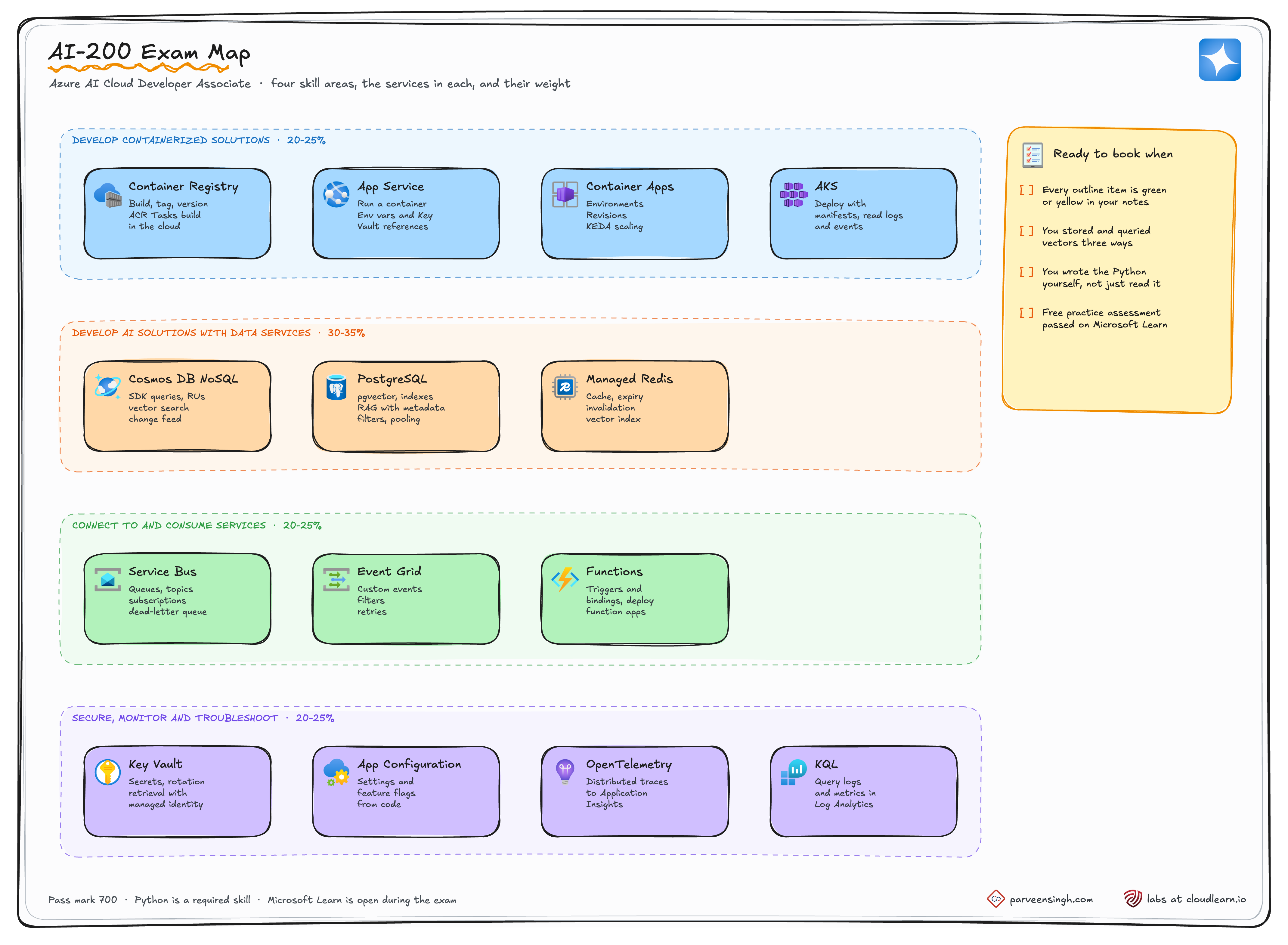
Weights from the official study guide, skills measured as of October 7, 2026.
| Skill area | Weight | What sits inside |
|---|---|---|
| Develop containerized solutions on Azure | 20 to 25% | ACR, ACR Tasks, App Service containers, Container Apps revisions, KEDA, AKS manifests, logs and connectivity |
| Develop AI solutions by using Azure data management services | 30 to 35% | Cosmos DB for NoSQL (SDK, RUs, vectors, change feed), PostgreSQL with pgvector, Azure Managed Redis |
| Connect to and consume Azure services | 20 to 25% | Service Bus, Event Grid, Azure Functions |
| Secure, monitor, and troubleshoot Azure solutions | 20 to 25% | Key Vault rotation, App Configuration, OpenTelemetry, KQL |
The data area is both the heaviest and the newest. That is where most AZ-204 holders need the extra hours.
🔄 What changed from AZ-204
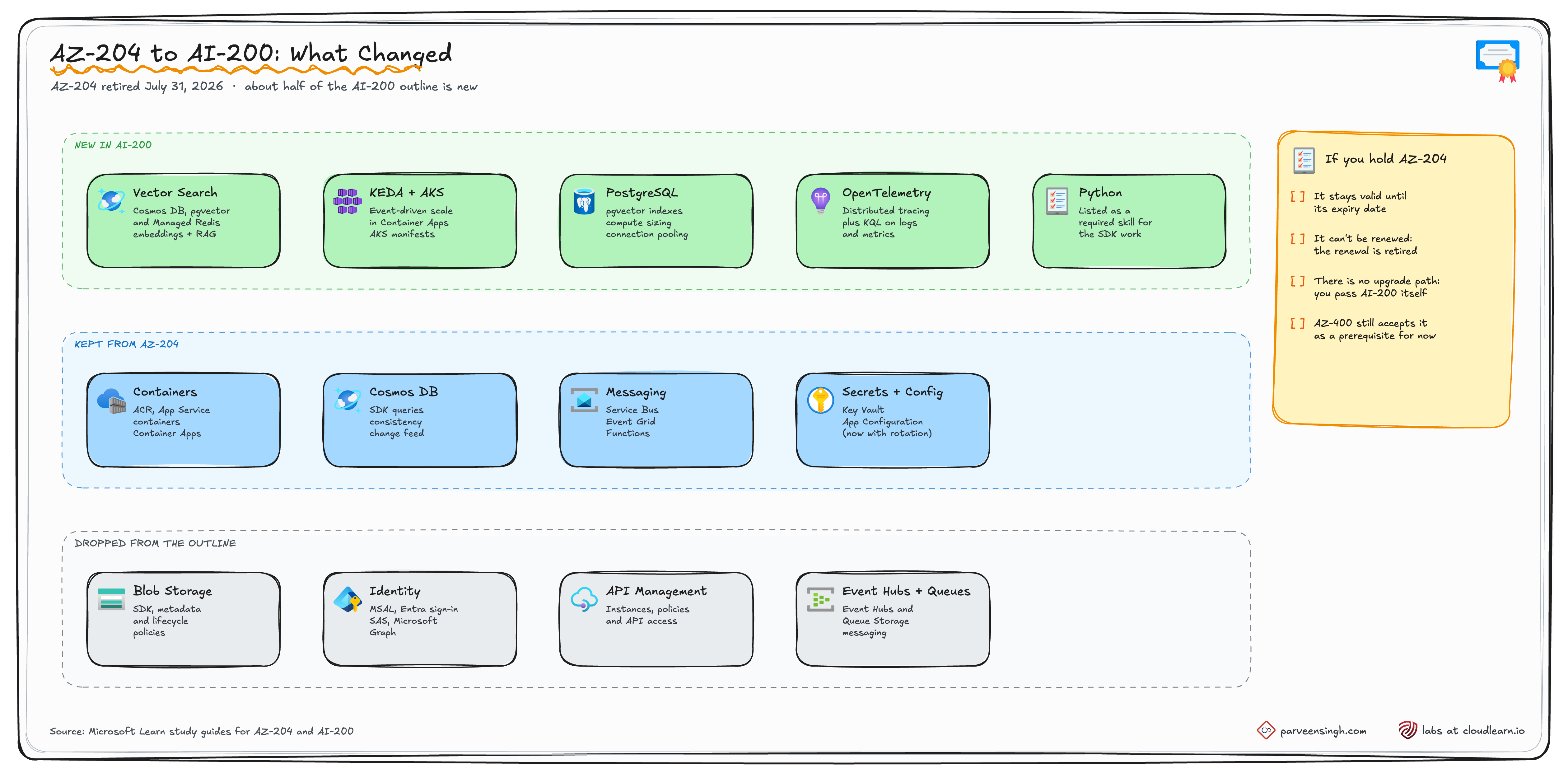
Dropped
| Topic | AZ-204 had | AI-200 |
|---|---|---|
| Identity | Microsoft identity platform, Entra ID sign-in, SAS, Microsoft Graph | Not in the outline |
| APIs | API Management | Not in the outline |
| Storage | Blob Storage | Not in the outline |
| Web apps | Slots, autoscale, TLS, diagnostics | App Service only as a container host |
| Messaging | Event Hubs, Queue Storage | Not in the outline |
| Containers | Container Instances | Not in the outline |
Kept
| Topic | Still on AI-200 |
|---|---|
| Containers | ACR, Container Apps |
| Data | Cosmos DB for NoSQL |
| Secrets and config | Key Vault, App Configuration |
| Messaging | Service Bus, Event Grid |
| Compute | Azure Functions triggers and bindings |
New
| Topic | What is new |
|---|---|
| Containers | ACR Tasks, KEDA scale rules in Container Apps, AKS with manifests |
| Data | Cosmos DB vector search and change feed processor, PostgreSQL with pgvector, Azure Managed Redis with vector indexing |
| Secrets | Key Vault rotation, not only retrieval |
| Monitoring | OpenTelemetry tracing and KQL, replacing the Application Insights focus |
| Language | Python listed as a required skill |
Already hold AZ-204?
- It stays valid until its current expiry date.
- It cannot be renewed. The renewal assessment retired with the exam.
- After expiry it shows on your transcript as expired.
- No upgrade path. To hold the new cert, you pass AI-200.
🧰 Services that matter, one thing each
| Service | The one thing to know |
|---|---|
| Azure Container Registry | Build, tag and version images. ACR Tasks builds them in the cloud, no local Docker needed |
| App Service | Only as a container host. Know how it supplies environment variables and secrets, including Key Vault references |
| Container Apps | Environments, revisions and traffic splitting. Know when to pick it over AKS or App Service |
| KEDA in Container Apps | Scale rules driven by events, such as messages landing in a Service Bus queue, including scale from zero |
| AKS | Deploy with a manifest and kubectl, then read logs and events. Not admin-level |
| Cosmos DB for NoSQL | Indexing policy and consistency level both change the RU charge. Vector search and the change feed processor are in scope |
| PostgreSQL with pgvector | Vector columns, index choice to cut latency and compute, connection pooling with PgBouncer, metadata filters for RAG |
| Azure Managed Redis | Caching with expiration and invalidation, plus vector indexing for similarity search |
| Service Bus | Messages that must be processed. Queues, topics, subscriptions, dead-letter queues |
| Event Grid | Tells subscribers something happened. Custom events, filters, retry policy |
| Azure Functions | Triggers and bindings, especially the Python v2 model where they are decorators in code |
| Key Vault | Rotation and retrieval of secrets, read from code with a managed identity |
| App Configuration | Store and read app settings from code |
| OpenTelemetry | Distributed tracing with the Azure Monitor OpenTelemetry SDKs |
| KQL | Short queries that filter, summarize and chart logs and metrics |
The comparison that shows up again and again is Service Bus versus Event Grid. Service Bus carries work. Event Grid carries news.
🧭 Vector search in Cosmos DB for NoSQL
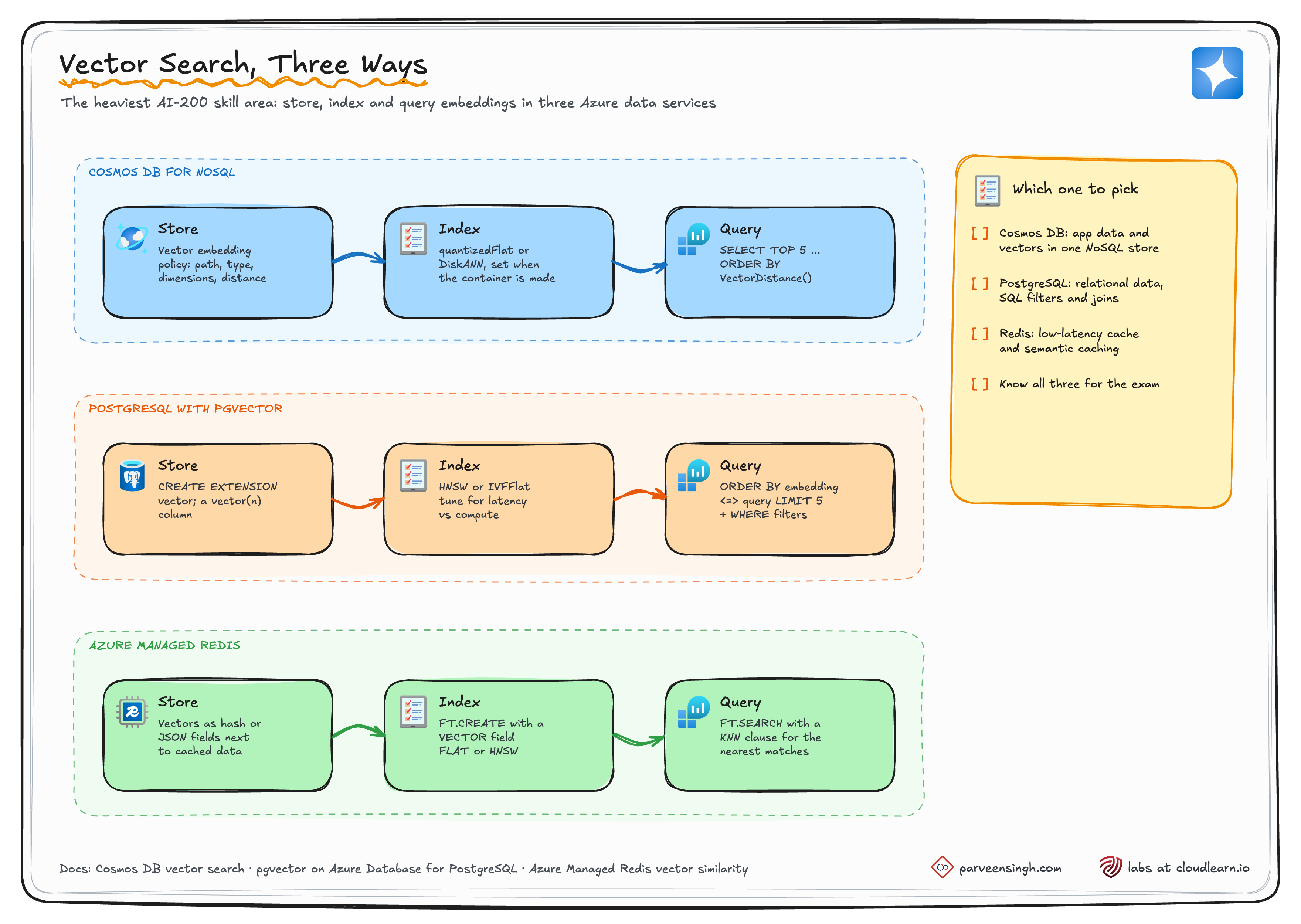
This is the newest material for most people, so here is only what the outline asks for: store embeddings, index them, query them. Learn the same three verbs for pgvector and Managed Redis too, and know when you would pick each.
Step 1: turn the feature on
Vector search is an account capability. It is auto-approved but can take about 15 minutes to apply.
az cosmosdb update \
  --resource-group rg-ai200 \
  --name cosmos-ai200 \
  --capabilities EnableNoSQLVectorSearch
Step 2: the container vector policy
The policy tells Cosmos DB where the vectors live and how to compare them.
| Property | Values | Default |
|---|---|---|
path | Property holding the vector (required) | None |
dataType | float32, float16, int8, uint8 | float32 |
dimensions | Length of every vector at that path | 1536 |
distanceFunction | cosine, dotproduct, euclidean | cosine |
{
  "vectorEmbeddings": [
    {
      "path": "/contentVector",
      "dataType": "float32",
      "distanceFunction": "cosine",
      "dimensions": 1536
    }
  ]
}Step 3: pick the vector index type
| Index | Search | Max dimensions | Pick it when |
|---|---|---|---|
flat | Exact, brute force, 100% recall | 505 | Small vectors and you need exact results |
quantizedFlat | Brute force over compressed vectors | 4,096 | The search is scoped (filters, partition) to about 50,000 vectors or fewer |
diskANN | Approximate nearest neighbour | 4,096 | Searches cover more than about 50,000 vectors and you want the lowest latency and RU cost |
quantizedFlat and diskANN need at least 1,000 vectors before they kick in. Below that, Cosmos DB runs a full scan. Exclude the vector path from the regular index so it is not indexed twice:
{
  "indexingMode": "consistent",
  "automatic": true,
  "includedPaths": [ { "path": "/*" } ],
  "excludedPaths": [
    { "path": "/_etag/?" },
    { "path": "/contentVector/*" }
  ],
  "vectorIndexes": [
    { "path": "/contentVector", "type": "diskANN" }
  ]
}
Step 4: query with VectorDistance
SELECT TOP 10 c.title, VectorDistance(c.contentVector, @queryVector) AS SimilarityScore
FROM c
ORDER BY VectorDistance(c.contentVector, @queryVector)| Remember | Why |
|---|---|
Always use TOP N | Without it the query returns far more results and burns RUs |
Combine with WHERE | Normal filters and partition keys narrow the vector search |
diskANN is approximate | The same query can return slightly different order between runs |
Third argument true | Forces brute force instead of the index |
⏭️ What to skip
These were AZ-204 staples. They are not in the AI-200 outline, so do not spend hours on them.
- Microsoft identity platform, MSAL sign-in flows and Microsoft Graph
- Shared access signatures
- Blob Storage tiers, lifecycle and SDK
- API Management policies
- Event Hubs and Queue Storage
- Container Instances
- App Service deployment slots, autoscale and TLS
- Model training, tuning or evaluation. That is the AI engineer and data scientist track, not this one
Two things are not on the outline but are assumed knowledge: managed identities and basic Application Insights. You do not need to study them as topics, but you need to be able to use them.
🗓️ Four-week study plan
One week per skill area, with the heaviest one first while your energy is highest. If you already passed AZ-204, you can compress weeks 3 and 4 into one and call it a three-week plan.
| Week | Focus | Do this | Done when |
|---|---|---|---|
| 1 | Data management (30 to 35%) | Cosmos DB SDK queries, indexing policy and consistency vs RUs, vector policy and VectorDistance, change feed processor. Then pgvector tables, indexes and PgBouncer. Then Managed Redis caching and vector index | You have stored and queried embeddings in Cosmos DB from your own Python script |
| 2 | Containers (20 to 25%) | Push to ACR, run an ACR Task, deploy to App Service with env vars and secrets, Container Apps revisions and traffic split, a KEDA rule, one AKS manifest deploy and kubectl logs | A container app scales on queue messages |
| 3 | Connect (20 to 25%) | Service Bus queues, topics, subscriptions and dead-lettering. Event Grid custom events, filters and retries. Functions in the Python v2 model, deploy a function app | You have sent and received a Service Bus message in Python |
| 4 | Secure and monitor (20 to 25%), then review | Key Vault rotation and retrieval with a managed identity, App Configuration from code, OpenTelemetry tracing, KQL filter, summarize and render. Take the practice assessment, then re-study the weakest area | You score comfortably on the practice assessment and can write a KQL summarize from memory |
Write the Python yourself every week. Reading SDK samples is not the same as connecting to Cosmos DB, sending a Service Bus message and reading a Key Vault secret from your own script.
🧪 Where to practise
Microsoft Learn
| Resource | Use it for |
|---|---|
| AI-200 study guide | The official skills outline. Your checklist |
| Free practice assessment | Official practice questions, week 4 |
| Certification page | Booking and price in your region |
| Build generative AI applications with Azure Cosmos DB | Vector storage, similarity search and RAG in Python. The closest single module to the data area |
| Vector search in Cosmos DB for NoSQL | The policy and index reference above, in full |
| Take your first steps with Python | If Python is new |
CloudLearn labs
Real Azure environment, guided steps, automatic checks, nothing left running afterwards.
For the assumed skills: Securing Azure Web Apps with Managed Identity and Key Vault and Getting Started with Azure Application Insights.
If you only do one lab this week, make it the KEDA one. Watching a container app scale from zero when messages hit the queue teaches more than any page about scale rules.
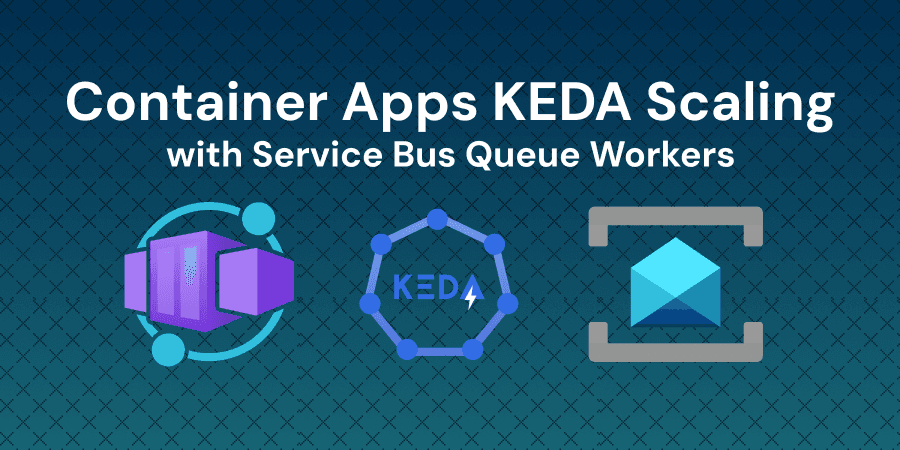
Container Apps KEDA Scaling with Service Bus Queue Workers
Wire a KEDA scale rule to a Service Bus queue and watch the app scale in a real Azure environment. Two AI-200 skill areas in one lab.
✅ Exam-day checklist
- Every outline item ticked, with something built for each
- Practice assessment taken at least once
- Exam sandbox tried
- Time limit per question set, slow ones marked for review
- Marked questions answered before taking the 5-minute break, because you cannot go back after it
- For online exams: clear desk, everything closed, Pearson VUE rules read the day before
- Booked at the time of day you think best
Where to go next after AI-200, and how it fits the rest of the 2027 map, is in the Azure Certification Roadmap 2027.
