
DP-203 retired on March 31, 2025. The Azure data engineer job is now certified per platform: DP-700 for Microsoft Fabric and DP-750 for Azure Databricks. The plan is four moves in order: learn the five skills both exams share, pick one platform by counting local job postings, build one medallion project, then sit the matching cert. Everything below is tables, checks and one code snippet you can run in either platform.
If someone told you to "just get DP-203", that exam can't be booked anymore. This page is the replacement plan. For the full certification landscape across every Azure track, see the Azure Certification Roadmap 2027.
🚨 What Changed
| Change | What it means |
|---|---|
| DP-203 retired March 31, 2025 | The Azure Data Engineer Associate cert, its exam and its renewal are gone. See the retired DP-203 study guide page. |
| Two platform certs replaced it | DP-700 is data engineering in Fabric. DP-750 is data engineering in Azure Databricks. Neither requires another cert first. |
| DP-750 outline updated October 19, 2026 | Small changes to data modeling and the development lifecycle. Study from the current DP-750 study guide, not an old copy. |
| Synapse is not the starting point | Still supported, but Microsoft ships the Fabric Migration Assistant to move Synapse dedicated SQL pools into Fabric. Start new learning on Fabric or Databricks. |
☕ My take: I moved 500 TB of healthcare data into Azure. The lesson that carries into 2027 is that the platform names change faster than the work. Ingest it, clean it, shape it, secure it, schedule it. Both new exams test that same work on different tools.
🗺️ The Plan at a Glance
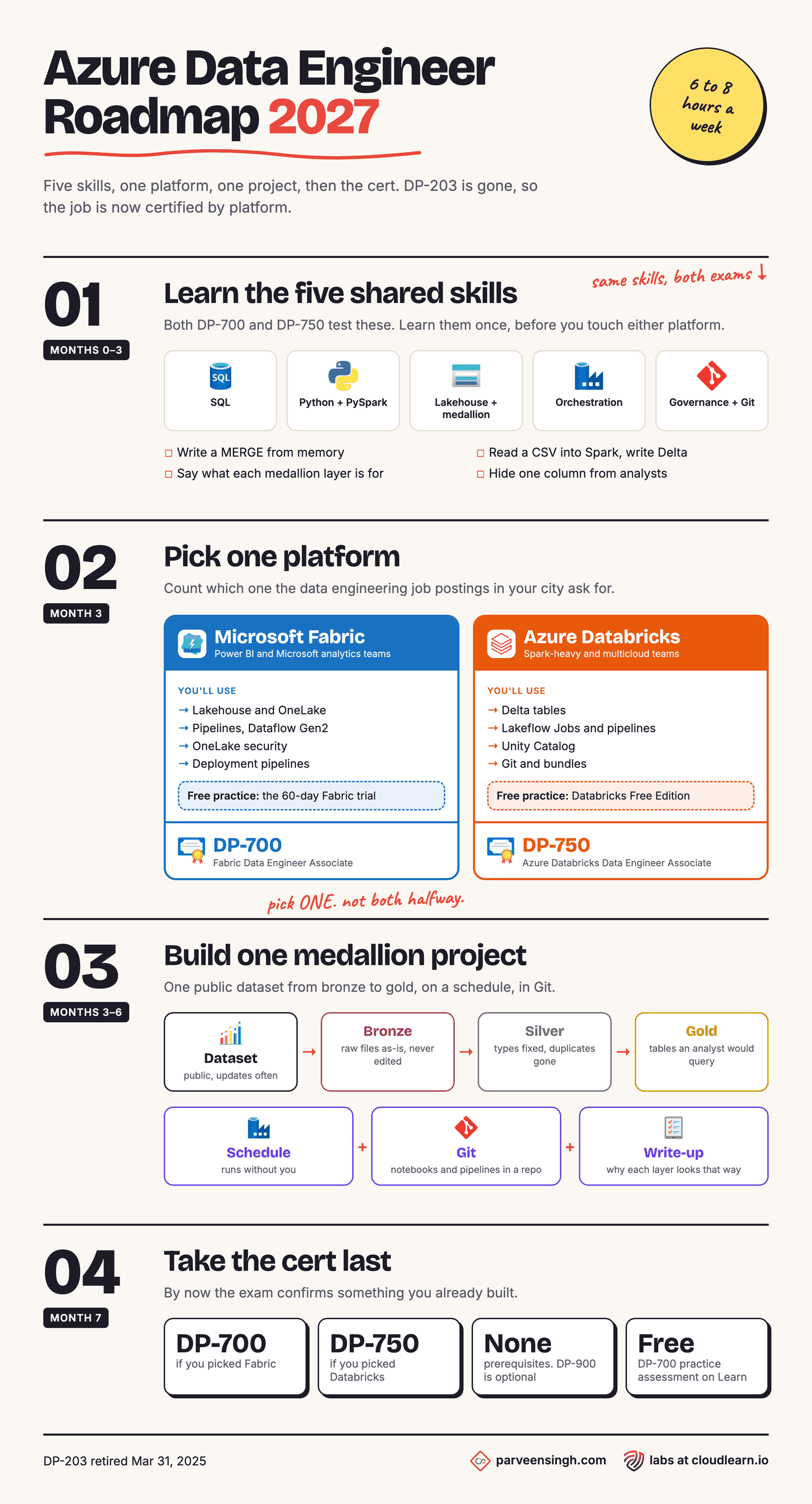
Timings assume 6 to 8 hours a week next to a full-time job.
| Stage | When | What you do | Done when |
|---|---|---|---|
| 1. Five shared skills | Months 0 to 3 | Learn what DP-700 and DP-750 both test | You pass the five checks below |
| 2. Pick one platform | Month 3 | Count Fabric vs Databricks in local job postings | You have one name and one free practice account |
| 3. One medallion project | Months 3 to 6 | One public dataset, bronze to gold, scheduled, in Git | All 7 checklist items are true |
| 4. The cert | Month 7 | DP-700 or DP-750 | The exam confirms what you already built |
🧱 Stage 1: The Five Shared Skills
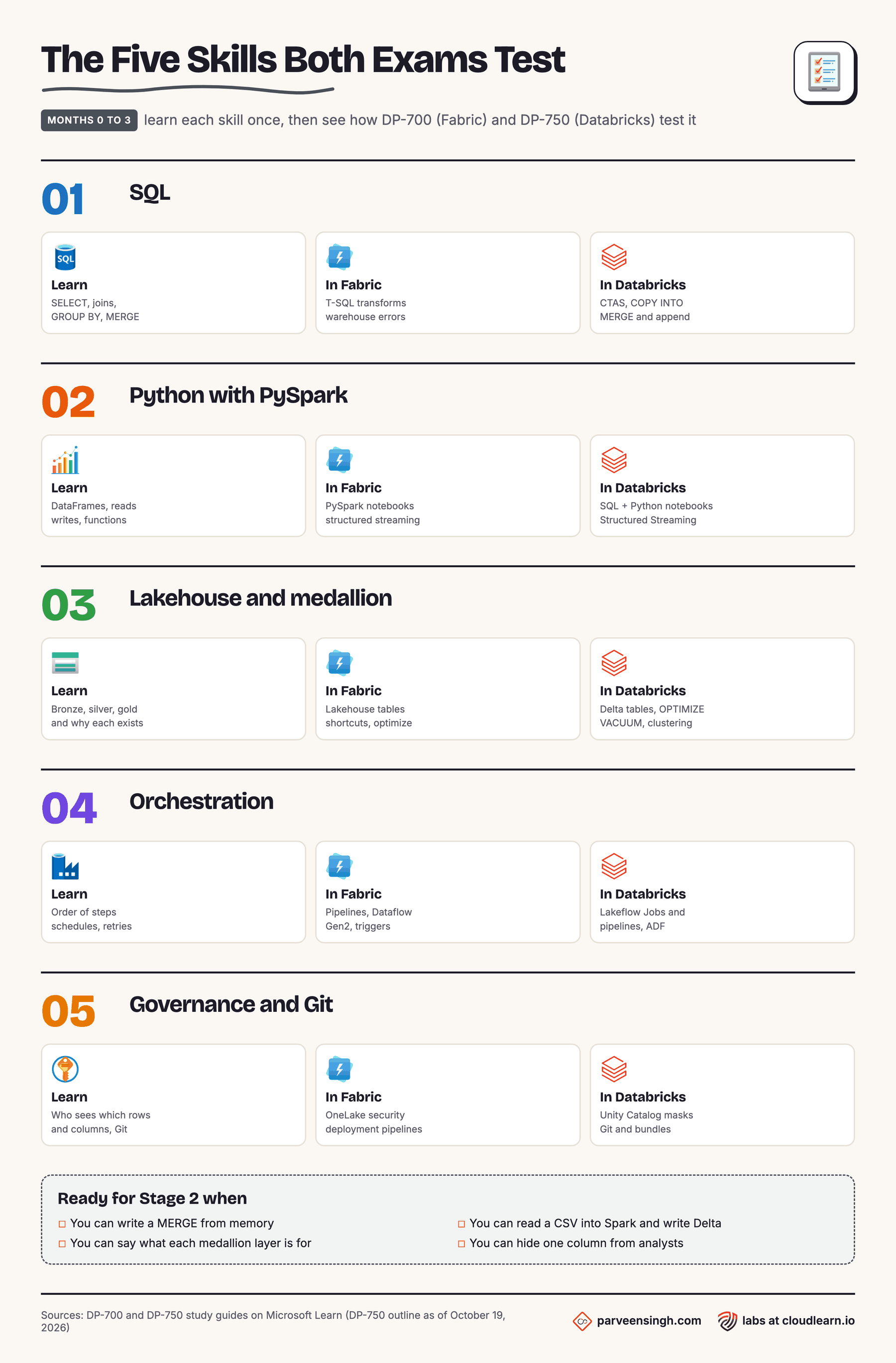
Same five skills, two platforms. Learn them platform-neutral first and a later switch costs you a tool, not a career.
| Skill | DP-700 (Fabric) angle | DP-750 (Databricks) angle | You're ready when |
|---|---|---|---|
| 1. SQL | T-SQL transforms, fixing warehouse errors | CREATE TABLE ... AS, COPY INTO, MERGE, INSERT and append loads | You can write a MERGE from memory |
| 2. Python with PySpark | PySpark in notebooks, Spark structured streaming | SQL and Python in notebooks, Structured Streaming | You can read a CSV into a DataFrame and save it as a Delta table |
| 3. Lakehouse and medallion | Lakehouse tables, OneLake shortcuts, table optimization | Delta tables, managed vs external, OPTIMIZE, VACUUM, liquid clustering | You can say why bronze, silver and gold each exist |
| 4. Orchestration | Picking Dataflow Gen2, pipelines or notebooks, schedules and event triggers | Lakeflow Jobs, Lakeflow Spark Declarative Pipelines, Azure Data Factory | You can run a notebook on a schedule without touching it |
| 5. Governance and Git | Row, column and object-level security, OneLake security, deployment pipelines | Unity Catalog row filters and column masks, Git branching, Declarative Automation Bundles | You can explain how to hide one column from analysts |
The medallion layers in one line each
- 🥉 Bronze: raw data, kept exactly as it arrived, so you can always rebuild.
- 🥈 Silver: cleaned data. This is where your data quality rules live.
- 🥇 Gold: shaped for the people who query it.
Microsoft calls this the recommended design approach for Fabric, and Databricks uses the same pattern.
Where to learn each skill for free
| Skill | Free resource |
|---|---|
| SQL | Query a real Azure SQL database from the Deploy Azure SQL Database with Terraform lab. Practise SELECT, joins, GROUP BY, MERGE. |
| PySpark | Notebooks in the Fabric trial or Databricks Free Edition |
| Lakehouse and medallion | Medallion architecture in Fabric |
| Orchestration | The "skills measured" lists in the DP-700 and DP-750 study guides |
| Governance | The Azure storage, network and secrets labs in the practice section below |
⚖️ Stage 2: Pick Fabric or Databricks
You need one platform properly, not two halfway.
The job-postings method
- Open the data engineering job postings in your city.
- Count how many name Fabric and how many name Databricks.
- Pick the bigger number. If it's a tie, pick the one your current employer uses.
- Start that platform's free option the same week.
| Microsoft Fabric | Azure Databricks | |
|---|---|---|
| Often found in | Teams already on Power BI and Microsoft analytics | Spark-heavy engineering teams and multicloud data platforms |
| Free way to practise | 60-day Fabric trial | Databricks Free Edition, serverless and quota-limited |
| The cert | DP-700 | DP-750 |
Picked the "wrong" one? The five skills carry across. Use the translation table below and you're mostly renaming things.
Fabric to Databricks: term by term
Closest equivalents, not exact twins. Each row links to the Microsoft Learn page behind it.
| Fabric term | Databricks closest match | What's the same, what's different |
|---|---|---|
| Lakehouse (a workspace item with a Tables area and a Files area) | A Unity Catalog catalog and schema holding tables and volumes, named catalog.schema.table | Both hold tables and raw files side by side. Databricks uses a three-level namespace instead of a single item. |
| OneLake (one logical data lake per Fabric tenant, provisioned for you) | Your own Azure Data Lake Storage governed by Unity Catalog | In Databricks you bring the storage account. Unity Catalog governs what's in it. |
| Shortcuts (point at data elsewhere without copying) | External locations with external tables or external volumes | Both reference existing storage instead of copying. Shortcuts also reach S3, GCS and other OneLake items. |
| Delta tables | Delta tables | Same open format. Delta is the default in a Fabric lakehouse and in Databricks. Your PySpark writes work in both. |
| Workspace roles plus OneLake security roles | Unity Catalog | Unity Catalog is one governance layer for privileges and policies across catalogs. Fabric splits it into workspace roles and OneLake security roles. |
| Workspace roles (Admin, Member, Contributor, Viewer) | Unity Catalog privileges granted with GRANT (USE CATALOG, USE SCHEMA, SELECT) | Fabric grants access by workspace or item. Unity Catalog grants on catalogs, schemas and tables, inherited downward. |
| OneLake security row-level and column-level security | Row filters and column masks | Same goal, different mechanism. Row filters and column masks are SQL functions bound to a table, or ABAC policies applied by tag. |
| Pipelines and Dataflow Gen2, plus notebook schedules | Lakeflow Jobs and Lakeflow Spark Declarative Pipelines, plus Azure Data Factory | Both sides schedule and chain notebooks. |
| Deployment pipelines (development, test, production stages) | Declarative Automation Bundles | Deployment pipelines copy workspace content stage to stage. Bundles (formerly Databricks Asset Bundles) define jobs and pipelines in YAML and deploy with the Databricks CLI. |
| Files/ area of a lakehouse | Unity Catalog volumes at /Volumes/catalog/schema/volume/ | Both hold non-table files such as raw CSVs. Volumes are governed by Unity Catalog permissions. |
🏗️ Stage 3: The Medallion Project
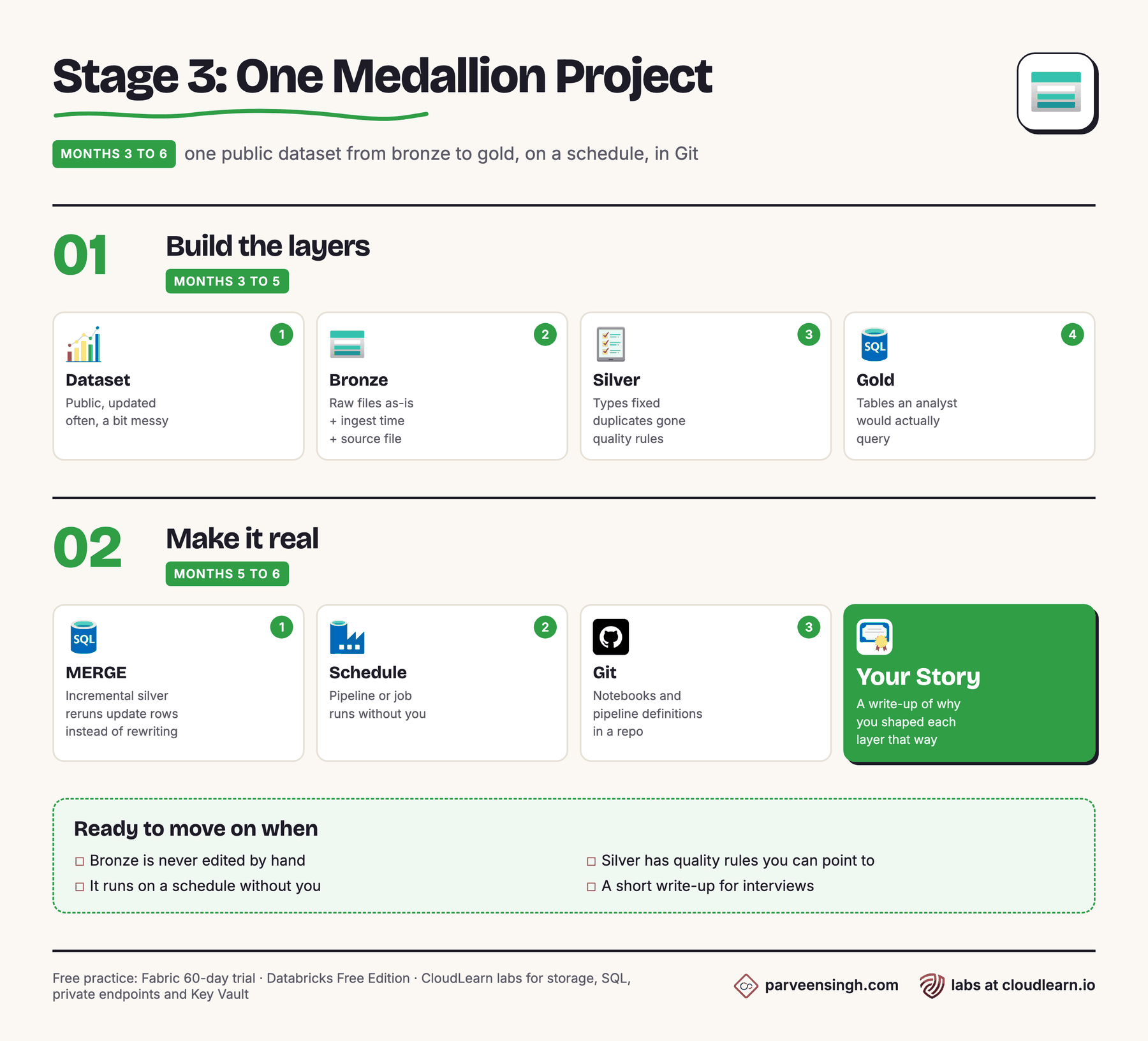
One public dataset, bronze to gold. Pick something that updates often and is a little messy: city open data, transit trips or weather records.
The 7-step checklist
- 1. Dataset. A public dataset that updates regularly. You can say what's in it and what's wrong with it.
- 2. Bronze. Raw files landed exactly as they arrive. A bronze table nobody edits by hand.
- 3. Silver. Types fixed, duplicates removed, nulls handled. Quality rules you can point to.
- 4. Gold. One or two aggregated tables that answer real questions an analyst would ask.
- 5. Schedule. The whole flow runs on a schedule without you.
- 6. Git. Notebooks and pipeline definitions in a repository someone else could read.
- 7. Decisions. A short write-up of why each layer is shaped the way it is. This is your interview answer.
The core code (runs in Fabric or Databricks)
from pyspark.sql import functions as F

# Bronze: land the raw file as-is, with when and where it came from
raw = (spark.read.option("header", True).csv("Files/raw/trips/*.csv")
       .withColumn("_ingested_at", F.current_timestamp())
       .withColumn("_source_file", F.col("_metadata.file_path")))
raw.write.format("delta").mode("append").saveAsTable("bronze_trips")

# Silver: fix types, drop duplicates and rows that fail basic checks
silver = (spark.table("bronze_trips")
          .withColumn("trip_date", F.to_date("pickup_datetime"))
          .withColumn("fare", F.col("fare").cast("decimal(10,2)"))
          .dropDuplicates(["trip_id"])
          .filter(F.col("fare") >= 0)
          .select("trip_id", "trip_date", "fare"))
silver.write.format("delta").mode("overwrite").saveAsTable("silver_trips")

# Gold: shape it for the people who use it
gold = (spark.table("silver_trips")
        .groupBy("trip_date")
        .agg(F.count("*").alias("trips"), F.sum("fare").alias("revenue")))
gold.write.format("delta").mode("overwrite").saveAsTable("gold_daily_revenue")| Platform | Change this one line |
|---|---|
| Fabric | Keep Files/raw/trips/*.csv. That's the lakehouse Files area. |
| Databricks | Read from a volume instead, for example /Volumes/main/trips/landing/raw/ (catalog main, schema trips, volume landing). |
Once the first full load works, switch silver to an incremental MERGE in Spark SQL so a rerun updates changed rows instead of rewriting the table. That one change also checks off the SQL "ready when" from Stage 1.
🎓 Stage 4: The Cert
The cert goes last so it confirms something you already built.
| DP-700 (Fabric) | DP-750 (Databricks) | |
|---|---|---|
| Certification | Fabric Data Engineer Associate | Azure Databricks Data Engineer Associate |
| Skill areas | Implement and manage an analytics solution, ingest and transform data, monitor and optimize. Each 30 to 35%. | Set up the environment (15 to 20%), secure and govern Unity Catalog (15 to 20%), prepare and process data (30 to 35%), deploy and maintain pipelines (30 to 35%) |
| Study guide | DP-700 study guide | DP-750 study guide |
| Free practice | DP-700 practice assessment | Check the practice assessments list |
| Prerequisites | None. DP-900 optional. | None. DP-900 optional. |
| Passing score | 700 | 700 |
Both exams let you open Microsoft Learn during the exam for the occasional lookup. Don't plan on it for every question.
Certs that look related but aren't the pipeline cert
| Exam | What it actually is | Take it if |
|---|---|---|
| DP-900 Azure Data Fundamentals | Core data concepts: relational, non-relational, analytics | You want vocabulary first. Optional. |
| DP-600 Fabric Analytics Engineer | Preparing data and building semantic models for reporting | You lean toward Power BI and analytics engineering |
| DP-800 SQL AI Developer | AI-enabled database solutions | You're a database developer, not a pipeline builder |
🧪 Free Ways to Practise
Fabric and Databricks both sit on top of Azure storage, databases, networking and secrets. CloudLearn has no Fabric or Databricks lab yet, so use the trial or Free Edition for the platform and these labs for the Azure pieces underneath.
| What to practise | Where | Cost |
|---|---|---|
| Fabric notebooks, lakehouse, pipelines | Fabric trial | Free for 60 days |
| Databricks notebooks, Unity Catalog, jobs | Databricks Free Edition | Free, quota-limited |
| Where raw files land | Getting Started with Azure Storage Account | CloudLearn lab |
| Keeping raw data without paying forever | Object Replication and Lifecycle Management | CloudLearn lab |
| A source database to ingest from | Deploy Azure SQL Database with Terraform | CloudLearn lab |
| Private network access to data | Azure Private Endpoints: Lock Down Your Storage and SQL | CloudLearn lab |
| Connection secrets for pipelines | Deploying and Managing Azure Key Vault | CloudLearn lab |
| KQL, which DP-700 also tests | Introduction to KQL in Azure Log Analytics | CloudLearn lab |
| Exam-style questions | Microsoft practice assessments | Free |
Start with storage. Every bronze layer on either platform ends up as files in a storage account, and knowing how that account is secured is half of the governance skill.
Getting Started with Azure Storage Account
Create the storage account where raw data lands, in a real Azure environment, with nothing left running afterwards.
🧭 The Order, in One Line
Five skills, one platform, one project, then the cert. Same work as the DP-203 days, new tools, and a project that proves it before the exam does.
