
Five AI roles are showing up again and again in cloud job postings: AI Engineer, AI Agent Developer, AI Cloud Engineer, MLOps Engineer, and AI Security Engineer. This note maps each one to what it actually does, the skills employers list, the certifications that match, and a hands-on lab to start with. Pick one and go deep rather than sampling all five.
🧭 How to read this list
A caveat worth stating up front: nobody knows exactly what the 2027 job market looks like. What I can tell you is what is in job postings right now, because that is where these five titles came from. Job titles change faster than the underlying work does, so treat the titles as labels and the skills tables as the real content.
Three things I have noticed training and coaching people through this transition:
- 🧱 These roles are cloud roles first. Almost every one of them assumes you can already deploy, network, secure, and monitor something. AI sits on top of that, not instead of it.
- 🎯 Depth beats breadth here. Someone who can genuinely ship one AI application beats someone who has watched courses on all five.
- 🔁 They overlap heavily. Skills you build for one transfer to the next. The order you pick matters less than picking.
1️⃣ AI Engineer
Builds and ships AI-powered applications using existing models, APIs, and cloud services.
This is the highest-volume role of the five. You are not training models from scratch. You are wiring a strong existing model into a product: prompt design, retrieval, tool calling, evaluation, cost control, and the plumbing that makes it reliable in production.
🔧 What the postings actually ask for
| Skill | Why it shows up |
|---|---|
| Python or TypeScript | Nearly every AI SDK is one of these two |
| Model APIs (Azure OpenAI, Anthropic, Bedrock) | The core of the job |
| RAG and vector search | The default pattern for "answer from our documents" |
| Prompt design and evaluation | Shipping without evals is how teams get burned |
| Token and cost management | Someone has to explain the bill |
| REST APIs, auth, async patterns | It is still software engineering |
🎓 Certifications that map
| Certification | Notes |
|---|---|
| AI-901 Azure AI Fundamentals | Fast vocabulary win, not a hiring signal on its own |
| AI-103 Azure AI Apps and Agents Developer Associate | The closest direct match on the Microsoft side |
| AWS Certified AI Practitioner | AWS equivalent at the fundamentals tier |
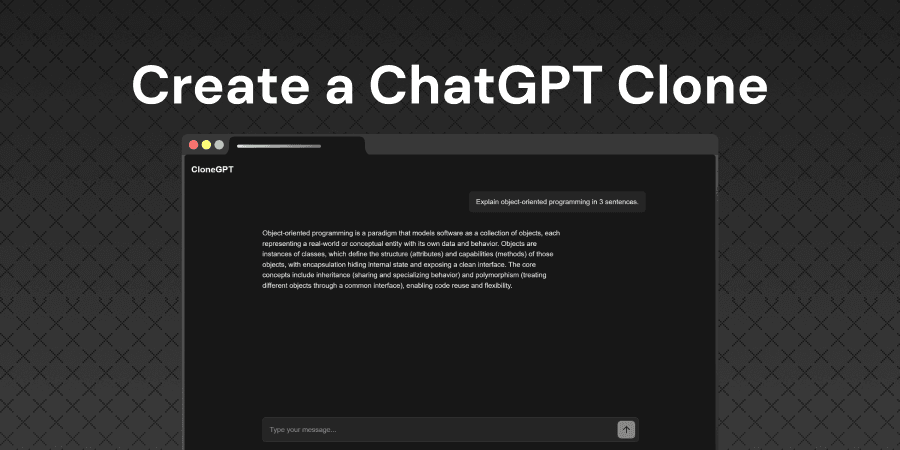
Build a ChatGPT Clone with Next.js and Azure OpenAI
The fastest way to understand this role is to ship the thing it ships. Streaming responses, API keys, and deployment, end to end.
2️⃣ AI Agent Developer
Builds AI systems that reason across multiple steps, call tools, and complete workflows without a human driving each turn.
The distinction from AI Engineer is the loop. A chatbot answers. An agent decides, acts, observes the result, and decides again. That difference brings in a whole set of concerns: tool schemas, state, retries, guardrails, cost ceilings, and knowing when to hand back to a human.
This is the newest of the five titles and the least standardized. Two companies advertising "AI Agent Developer" may mean quite different things, so read the posting body rather than the title.
🔧 What the postings actually ask for
| Skill | Why it shows up |
|---|---|
| Tool and function calling | The mechanism that lets a model do anything |
| Agent frameworks and SDKs | Azure AI Foundry Agent Service, LangGraph, and similar |
| MCP (Model Context Protocol) | Increasingly the standard way to expose tools to models |
| Workflow and state design | Multi-step means state has to live somewhere |
| Guardrails and human-in-the-loop | Autonomy without brakes does not survive a security review |
| Observability and tracing | You cannot debug an agent you cannot see |
🎓 Certifications that map
AI-103 Azure AI Apps and Agents Developer now covers agents directly. If you build agents in Copilot Studio rather than in code, look at AB-620 AI Agent Builder. Either way, your portfolio does the talking here.
Trace Your AI Applications and Collect User Feedback
Observability is the skill that makes agents debuggable, and it is the part most people skip. Build the tracing first and the rest of the loop gets far easier to reason about.
For the agent frameworks themselves, the Azure AI Foundry Agent Service docs are the best current reference on tool calling, threads, and agent state.
3️⃣ AI Cloud Engineer
Runs the infrastructure that AI workloads sit on: networking, identity, scaling, cost, and deployment.
This is the role most existing cloud engineers can move into fastest, because roughly 70 percent of it is the job you already do. The new part is what AI workloads demand that ordinary web apps do not: GPU capacity and quota, private networking to model endpoints, token-based cost models, and data residency questions that get asked much harder when a model is involved.
🔧 What the postings actually ask for
| Skill | Why it shows up |
|---|---|
| Core cloud infrastructure | VNets, subnets, NSGs, private endpoints |
| Managed identity and Key Vault | Nobody wants model API keys in app settings |
| GPU and quota management | Capacity is the constraint that bites first |
| Cost governance for token spend | Unbounded model calls become an unbounded bill |
| IaC (Terraform or Bicep) | AI environments get rebuilt constantly |
| Monitoring and observability | Latency and failure patterns differ from normal apps |
🎓 Certifications that map
| Certification | Notes |
|---|---|
| AZ-104 Azure Administrator Associate | The strongest foundation for this role |
| AZ-305 Azure Solutions Architect Expert | For the design side |
| AI-103 Azure AI Apps and Agents Developer Associate | Covers the AI services layer |
Deploy and Manage Azure Key Vault
Model API keys and connection secrets belong here, not in your app config. This is the first thing to get right on any AI workload.
4️⃣ MLOps Engineer
Takes machine learning from a notebook to something that runs reliably in production.
The oldest and most established of the five. It exists because the gap between "the model works on my machine" and "the model serves traffic, gets monitored, and can be rolled back" is enormous, and it is an engineering gap rather than a data science one.
Worth being honest about: this role usually expects more genuine ML background than the other four. If you are coming from infrastructure, it is a longer runway.
🔧 What the postings actually ask for
| Skill | Why it shows up |
|---|---|
| CI/CD for models, not just code | Retraining and redeploying has to be routine |
| Experiment tracking and model registry | Reproducibility is the whole point |
| Data and feature pipelines | Models are downstream of data plumbing |
| Model monitoring and drift detection | Models degrade quietly |
| Containers and orchestration | Serving usually means containers |
| Python plus a framework | PyTorch, scikit-learn, or similar |
🎓 Certifications that map
| Certification | Notes |
|---|---|
| AI-300 Machine Learning Operations Engineer | The direct Microsoft match for this role |
| AZ-400 DevOps Engineer Expert | The pipeline and automation half |
| AWS Certified Machine Learning Engineer Associate | The clearest MLOps-specific cert of the group |

Azure Machine Learning Documentation
No CloudLearn MLOps lab yet. Start with the Azure ML docs on pipelines, model registry, and endpoints - that is the core of the role.
5️⃣ AI Security Engineer
Protects AI applications, models, training data, and agents from attack and misuse.
The newest security specialization and, in my view, the most under-supplied relative to demand. Traditional application security does not cover prompt injection, model extraction, training-data poisoning, or an agent that has been talked into calling a tool it should not.
The strongest candidates I see here are existing security engineers who added AI knowledge, not the reverse. Security fundamentals are the hard part.
🔧 What the postings actually ask for
| Skill | Why it shows up |
|---|---|
| Prompt injection and jailbreak defence | The signature attack class for LLM apps |
| Identity and least privilege for agents | An agent's tool permissions are its blast radius |
| Data protection and PII handling | What leaves your tenant and what does not |
| AI red teaming | Adversarial testing before someone else does it |
| Threat detection and incident response | SIEM work, applied to AI workloads |
| Governance frameworks | OWASP LLM Top 10, NIST AI RMF, EU AI Act |
🎓 Certifications that map
| Certification | Notes |
|---|---|
| SC-500 Cloud and AI Security Engineer | Core Azure security, including AI workloads |
| SC-200 Security Operations Analyst | Detection and response side |
| SC-100 Cybersecurity Architect Expert | The design and strategy tier |
Securing Azure AI Services: Best Practices and Configuration
The most directly relevant lab for this role. Locking down AI service endpoints, keys, and network access is the groundwork everything else in AI security sits on.
For the detection and response half of the role, the Sentinel analytics rules lab covers the SIEM skills that transfer directly onto AI workloads.
🗓️ Start this week
A 30-day path that works regardless of which of the five you picked:
| Week | What to do |
|---|---|
| Week 1 | Pick one role. Read 10 real job postings for it and write down every repeated requirement. That list is your actual syllabus, not any course outline. |
| Week 2 | Do the lab linked in that role's section above. Finish it. Break it on purpose and fix it. |
| Week 3 | Build one small thing of your own using those skills. Small and finished beats ambitious and abandoned. |
| Week 4 | Put it on GitHub with a README that explains the problem, the architecture, and what you would do differently. Then start the matching certification. |
📋 All five on one page
| Role | Core skill | Best first cert | Jump from infra? |
|---|---|---|---|
| AI Engineer | Ship apps on model APIs | AI-103 | Medium |
| AI Agent Developer | Tool calling and workflows | AI-103 | Medium |
| AI Cloud Engineer | Infra for AI workloads | AZ-104 then AI-103 | Easiest |
| MLOps Engineer | ML in production | AI-300 or AWS MLA | Hardest |
| AI Security Engineer | Securing models and agents | SC-500 then SC-200 | Medium, if security background |
CloudLearn: the full lab library
The individual labs linked above live on CloudLearn, along with the AI, networking, security, and IaC labs behind the rest of these roles. Real Azure environments that spin up in your browser, no subscription of your own required.
🔗 Where to go next
- 4 Cloud Skills That Actually Get You Hired in 2027 - the foundation underneath all five of these roles
- 4 Projects That Make a Cloud Resume Impossible to Ignore - what to build once you have picked a direction
- Azure Certification Roadmap 2027 - full certification sequencing
Not sure which of the five fits your background?
I coach people through exactly this decision - mapping what you already have against where you want to land, and building the plan to get there. Tell me where you are and I will come back to you.
